
SIP vs Lumpsum: Which Investment Strategy Is Right for You?
“Should I invest a lumpsum or start a SIP?” is one of the most common questions we hear from clients — whether it’s a business owner who has just received a large payout, a salaried professional with a year-end bonus, or someone who simply has idle savings sitting in a bank account. There is no single universally correct answer; the right choice depends on your cash flow, the market environment, and your psychological comfort with volatility. This blog breaks down both approaches in detail.
What Is a SIP?
A Systematic Investment Plan (SIP) allows you to invest a fixed amount at regular intervals — typically monthly — into a mutual fund scheme, automatically debited via a NACH mandate or UPI AutoPay. Instead of trying to find the “right” time to invest, a SIP spreads your investment across market highs and lows over time.
What Is a Lumpsum Investment?
A lumpsum investment means deploying your entire investable amount in one go, at the prevailing NAV, on a single date. This is common when investors receive a bonus, inheritance, maturity proceeds from another investment, or business profits that need to be deployed at once.
Rupee Cost Averaging: SIP’s Core Advantage
When you invest a fixed amount every month, you automatically buy more units when the market (and NAV) is low, and fewer units when the market is high. Over time, this averages out your purchase cost and reduces the risk of investing a large sum right before a market correction. This mechanism is called rupee cost averaging, and it is precisely why SIPs are recommended for investors who cannot (or prefer not to) actively track market valuations.
When Lumpsum Investing Works Better
- You have a large one-time surplus — such as a bonus, business sale proceeds, or an inheritance — that isn’t part of your regular monthly cash flow.
- Markets are reasonably valued or have recently corrected — deploying a lumpsum after a meaningful market fall can capture the subsequent recovery more fully than a SIP would.
- Your investment horizon is genuinely long (10+ years) — over very long periods, the exact entry point matters progressively less, and being invested (rather than waiting on the sidelines) becomes the dominant factor in your returns.
- You want to avoid the risk of “timing your own SIP” — some investors mistakenly pause or delay SIPs trying to predict market tops, which defeats the entire purpose of disciplined investing.
When SIP Investing Works Better
- You have regular monthly income rather than one large surplus — the natural fit for most salaried and self-employed individuals.
- You want to avoid market-timing risk entirely — a SIP removes the emotional burden of deciding “is today a good day to invest?”
- Markets are volatile or at elevated valuations — spreading entries reduces the risk of deploying a large sum right before a sharp correction.
- You are a first-time or conservative investor — the gradual, automated nature of SIPs builds investing discipline and reduces behavioural mistakes like panic-selling.
A Practical Middle Path: The STP Route
For investors who have a lumpsum but are uncomfortable deploying it all at once, a Systematic Transfer Plan (STP) offers a hybrid solution. You park the lumpsum in a liquid or debt fund and set up an automated transfer of a fixed amount into your chosen equity fund every week or month — effectively converting a lumpsum into a SIP-like staggered deployment over, say, 6–12 months, while the parked amount continues earning modest debt returns in the interim.
Comparing the Two at a Glance
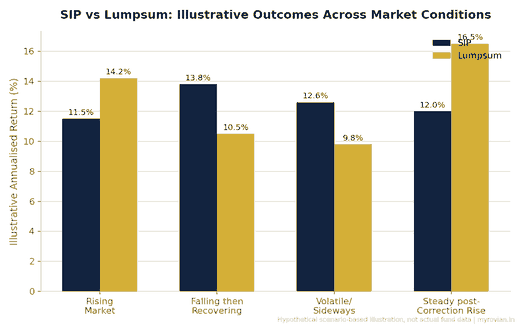
| Factor | SIP | Lumpsum |
|---|---|---|
| Best suited for | Regular monthly income | One-time large surplus |
| Market timing risk | Low (averaged over time) | Higher (single entry point) |
| Discipline required | Automated, low effort | Requires conviction to deploy fully |
| Ideal market condition | Volatile or uncertain markets | Undervalued or post-correction markets |
| Psychological comfort | Easier for most investors | Can be stressful if markets fall soon after |
Our Recommendation
For the vast majority of investors with regular income, SIP remains the more disciplined, lower-stress, and behaviourally sound approach — it removes guesswork and builds a long-term habit. For investors who come into a genuine one-time surplus, a combination approach works well: deploy a portion as lumpsum if valuations seem reasonable, and route the rest through an STP over the following months to balance opportunity against timing risk.
Key Takeaways
- SIP uses rupee cost averaging to reduce market-timing risk and suits regular monthly savers.
- Lumpsum can outperform when deployed during reasonable valuations with a long time horizon, but carries higher timing risk.
- An STP offers a practical middle ground for deploying a large surplus gradually.
- The “best” choice depends on your cash flow pattern and your ability to stay calm through short-term volatility — not on chasing the theoretically optimal strategy.
Unsure whether to invest your bonus or surplus as a lumpsum, via SIP, or through an STP? Our advisors at Rovian can review your specific situation and recommend the most suitable approach. Contact us to plan your next investment.
Mutual Fund investments are subject to market risks. Please read all scheme-related documents carefully before investing.