
Investing Through Mutual Funds: The Complete Guide for Indian Investors
For most Indians, “investing” used to mean a fixed deposit, a gold purchase, or perhaps a LIC policy passed down through the family. Mutual funds have quietly changed that. Today, crores of Indian households route their savings into equity, debt, and hybrid mutual funds every month through Systematic Investment Plans (SIPs) — and for good reason. Done correctly, mutual funds remain one of the most accessible, professionally managed, and tax-efficient ways to build long-term wealth. This guide walks you through everything you need to know before you invest a single rupee.
What Exactly Is a Mutual Fund?
A mutual fund is a pool of money collected from thousands of investors like you, managed by a professional fund manager, and invested in a diversified basket of stocks, bonds, or other securities depending on the fund’s stated objective. When you invest, you are allotted “units” of the fund at the prevailing Net Asset Value (NAV). As the underlying investments grow (or fall) in value, your units grow (or fall) proportionately.
The key advantages are simple: diversification you couldn’t easily achieve on your own with a small amount, professional fund management, regulatory oversight by SEBI, and the flexibility to start with amounts as small as ₹500 a month.
Types of Mutual Funds
- Equity Funds – Invest predominantly in stocks. Sub-categories include Large Cap (top 100 companies by market size, relatively stable), Mid Cap (next 150, higher growth and higher volatility), Small Cap (higher risk, higher long-term growth potential), Flexi Cap/Multi Cap (spread across market capitalisations), and Sectoral/Thematic funds (concentrated bets on one sector — higher risk).
- Debt Funds – Invest in government securities, corporate bonds, and money market instruments. Lower volatility, used mainly for short-to-medium term goals and for parking surplus funds.
- Hybrid Funds – A mix of equity and debt in varying proportions, offering a balance between growth and stability.
- ELSS (Tax-Saving Funds) – Equity funds with a 3-year lock-in that qualify for deduction under Section 80C of the Income Tax Act (old regime only).
- Index Funds – Passively track an index like the Nifty 50 or Sensex at a very low cost, with no attempt to beat the market.
Who Should Invest in Mutual Funds?
Almost every category of investor can find a suitable mutual fund, but the “right” fund depends entirely on your goals, time horizon, and risk appetite:
- Salaried individuals building a retirement corpus or saving for a child’s education can use equity or hybrid funds via SIP.
- Business owners and professionals with irregular but lump-sum cash flows can deploy surplus funds through lumpsum or STP (Systematic Transfer Plan) routes.
- First-time investors with low risk tolerance can start with hybrid or large-cap funds before graduating to mid/small cap exposure.
- Conservative investors and senior citizens nearing or in retirement are usually better served by debt or conservative hybrid funds, prioritising capital protection over growth.
The common thread: you should only invest money you will not need urgently in the short term, and your fund choice should match how much volatility you can genuinely tolerate without panic-selling.
How to Invest in Mutual Funds
- Complete your KYC – This is mandatory and one-time. You will need your PAN card, Aadhaar, a recent photograph, a cancelled cheque/bank proof, and to complete an in-person or video KYC (V-CIP) through a KYC Registration Agency (KRA) or your chosen platform.
- Choose Direct vs Regular Plans – Direct plans (bought straight from the AMC or a direct platform) carry no distributor commission and therefore a lower expense ratio and marginally higher long-term returns. Regular plans route through a distributor/advisor who earns a trail commission but can offer guidance, hand-holding, and consolidated servicing — useful for investors who prefer professional advice over a do-it-yourself approach.
- Select your platform – You can invest directly through an AMC’s website/app, through registrar platforms like CAMS or KFintech, through MF Utility, or through a registered Mutual Fund Distributor/advisor who can help you pick funds aligned to your goals and review your portfolio periodically.
- Decide SIP or Lumpsum – Set up a monthly SIP via NACH mandate or UPI AutoPay for disciplined investing, or invest a lumpsum when you have a large one-time surplus. (We cover this trade-off in detail in our separate blog on SIP vs Lumpsum.)
- Track and review – Review your portfolio at least once a year against your goals, rather than reacting to daily market noise.
Past Returns Across Categories
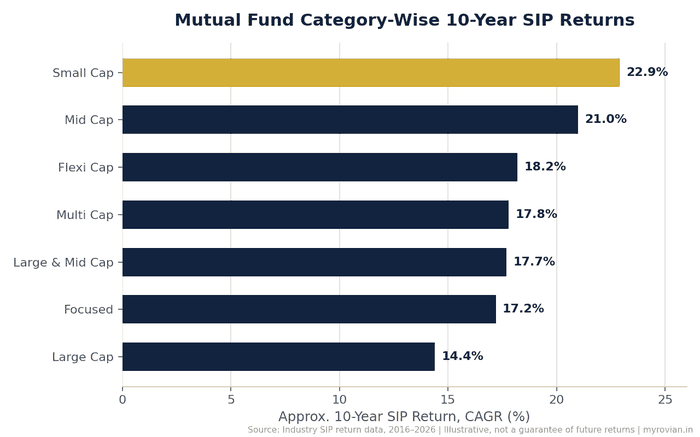
Past performance is never a guarantee of future returns, but it helps set realistic expectations. Here is how a 10-year SIP (2016–2026) has performed on average across popular equity categories in India:
| Fund Category | Approx. 10-Year SIP Return (CAGR) |
|---|---|
| Small Cap | ~22–23% |
| Mid Cap | ~20–21% |
| Flexi Cap | ~18% |
| Multi Cap | ~17–18% |
| Large & Mid Cap | ~17–18% |
| Large Cap | ~14–15% |
Notice the pattern: categories with higher short-term volatility (small and mid cap) have historically rewarded patient, long-term SIP investors with higher returns — but they also fall harder during corrections. This is precisely why fund selection must match your personal risk appetite, not just the category with the highest past return.
Ideal Tenure for Investing
- Equity Mutual Funds: A minimum of 5–7 years, ideally 10+ years, to ride out market cycles and let compounding work. Small and mid cap funds need an even longer runway — think 8–10 years minimum.
- Hybrid Funds: 3–5 years, suitable for medium-term goals.
- Debt Funds: From a few months up to 3 years, depending on the sub-category, for near-term goals or parking surplus money.
- ELSS: 3-year statutory lock-in, but best held much longer like any equity fund for optimal growth.
Important Points Before You Invest
- Never invest based solely on past returns — check the fund’s consistency, the fund manager’s track record, expense ratio, and portfolio concentration.
- Diversify across categories rather than chasing the single best-performing fund of the previous year.
- Align every investment to a specific goal (retirement, child’s education, down payment) and tenure — this discipline prevents emotional decision-making.
- Understand the exit load and taxation (LTCG/STCG rules) applicable to the fund category before redeeming.
- Avoid over-diversification — owning 15–20 funds rarely helps; 4–6 well-chosen funds across categories are usually sufficient for most individual investors.
Key Takeaways
- Mutual funds offer professional management, diversification, and flexibility for every type of investor.
- Match fund category and risk to your personal goals and time horizon — not the other way around.
- Stay invested for the recommended tenure; mutual fund wealth creation genuinely rewards patience.
- Review periodically, but resist the urge to react to short-term market noise.
If you are unsure which combination of funds suits your income, goals, and risk profile, our team at Rovian can help you build a personalised investment plan — from fund selection to portfolio review. Get in touch with us today to start your investment journey the right way.
Mutual Fund investments are subject to market risks. Please read all scheme-related documents carefully before investing.